The Gazelle and the Lion
The only way for a gazelle to kill a lion is to become human: to hold a rifle two centimetres from his face, and lower it. A parable about power and the freedom not to use it.
TL;DR. A parable to hand down: the gazelle who, to kill the lion, becomes human. Not by taking his life, but by being able to and choosing not to, before knowing what he will do. The parable in pictures. Anche in italiano.
The only way for a gazelle to kill a lion is to become human.
The Law of the Savanna
They say that every morning in Africa a gazelle wakes up knowing she must outrun the lion, or die. This is the story of the gazelle who stopped running.
All her life she had run. She had grown faster, quicker to turn, quicker to hear him in the grass. But she knew that one day it would not be enough. No gazelle runs forever.
Iron and Fire
So she did what no gazelle had ever done. She rose on her hind legs, learned the fire of the forge and the weight of the hammer, and beat the iron until the iron obeyed. Out of it came a rifle.
She went back to the same acacia. The lion was there, as always. She raised the rifle and held it to his face, two centimetres from his muzzle.
Now she was as dangerous as he was. But that did not yet make her a predator. The iron had given her a power; it had not told her what to do with it. Had she fired, she would have become a lion. To become human, she had to lower it.
The Standoff
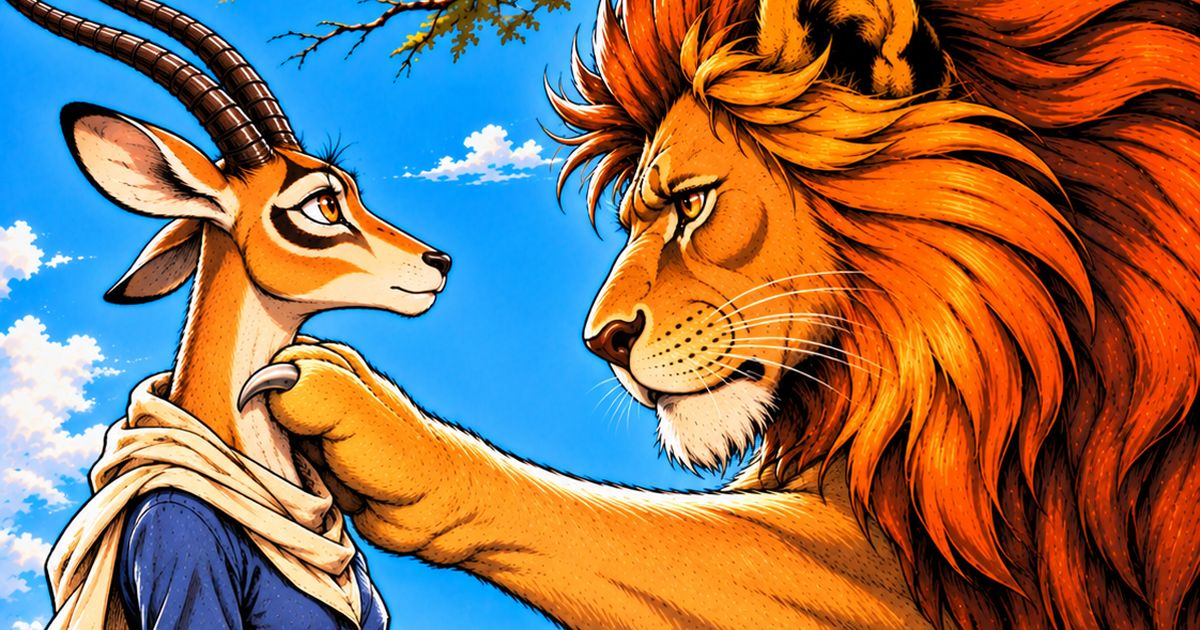
The lion looked her in the eyes. Then, slowly, he raised a paw and set one claw against her throat.
She could fire. He could strike. Neither was safe, and neither had yet chosen. The savanna held its breath.
The First Renunciation
The gazelle chose first. She lowered the rifle, while the claw was still at her throat.
She asked for nothing in return. She did not know what the lion would do. An exchange of disarmaments would have been a bargain; this was a gift offered first, with no guarantee.
The iron had given her the blacksmith’s apron. The renunciation gave her the clothes of a human being.
The first renunciation does not buy the second. It makes it possible.
The Lion’s Hat
Now the choice was the lion’s, and he had never had it before. To a lion, a gazelle is only prey.
He drew back his claw. He spared his natural prey, as she had spared him, and walked away down the path, looking back only once.
He did not rise on two legs. He did not put on clothes. He stayed a lion in body, in strength, in stride. But from that day he wore a hat: just one, the sign that something human had entered him too.
That day, beneath the acacia, a predator died, and no blood was shed. The gazelle had killed the lion without taking his life.
The Gazelle’s Legend
Some tell this story another way. In their telling the lion stays a lion, and takes the gazelle.
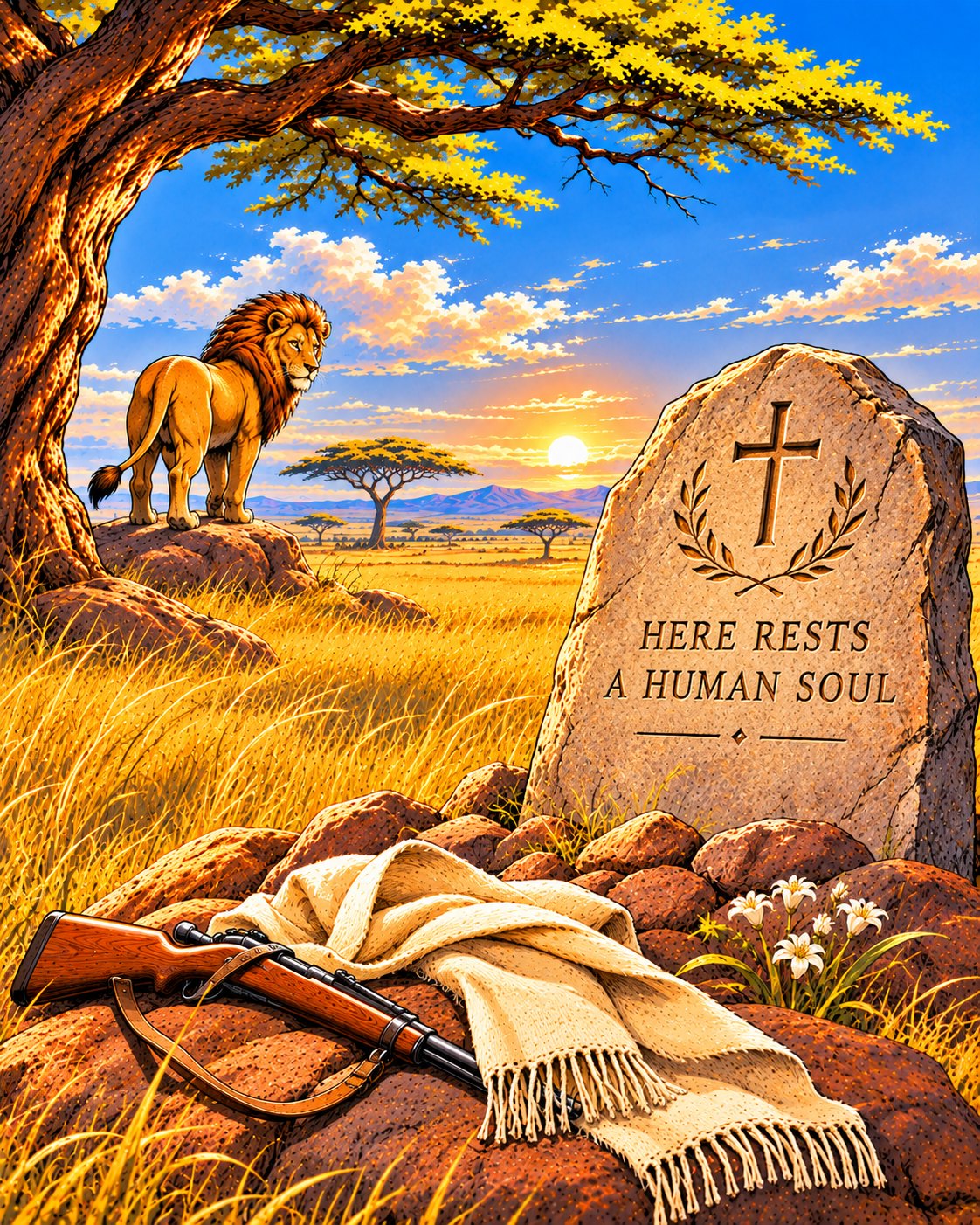 The other telling.
Yet even in that telling, nothing changes for her. On the rock lie the scarf and the rifle, and her legend is the same: she was born a gazelle, and she died a human being. Here rests a human soul. What the lion does with mercy does not undo the one who offered it.
This story does not ask anyone under threat to lower the rifle. It tells what becomes of the one who chooses to.
What Is Handed Down
Whoever learns iron grows strong. Whoever fires becomes a lion. Whoever lowers the rifle becomes human. And the first renunciation does not buy the second: it makes it possible.
Inside this story there is another: the lion who knows he is a lion, has nothing to prove, and spends all his strength on not acting like one. That story, and the Lamb it leads to, will have their own panels.
The story and its moral are mine. I revised it in conversation with ChatGPT, which also wrote the image prompts and generated the images.